
EV Battery Busbar Applications
BusbarMFG is an engineering-first custom busbar manufacturer in Dongguan, Guangdong, China. We build drawing-based copper and aluminum busbars and battery interconnect components used throughout EV battery modules and packs, energy storage, power electronics,
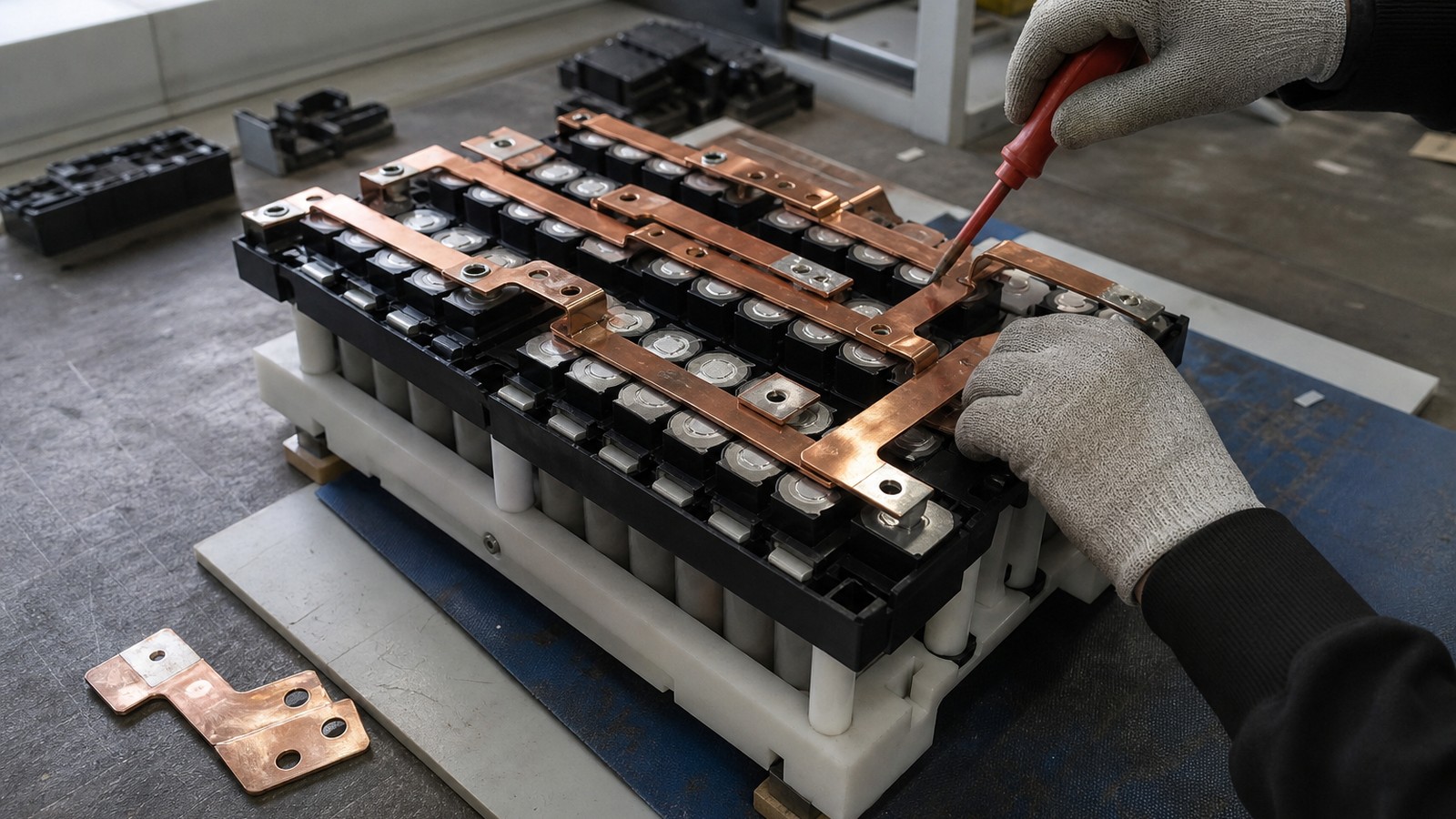
Custom busbar manufacturing
Engineering details are organized around material, tolerance, surface finish, inspection, and production readiness.
Use the inquiry module to send drawings, quantities, standards, and delivery targets for a practical manufacturing review.
Service Details
BusbarMFG is an engineering-first custom busbar manufacturer in Dongguan, Guangdong, China. We build drawing-based copper and aluminum busbars and battery interconnect components used throughout EV battery modules and packs, energy storage, power electronics, charging equipment, switchgear, and industrial power distribution.
Our focus is helping engineering-led OEM teams turn EV battery busbar designs into production-ready parts with manufacturability feedback, prototypes, validation lots, and repeat production.
From Drawing to Production-Ready Busbars
Every EV battery project starts with your drawing and application requirements. Our engineering review can cover:
- Material selection (copper or aluminum)
- Thickness and stackups
- Insulation type and coverage
- Plating specification (tin, nickel, silver)
- Bends, holes, slots, and cutouts
- Interface features and connection methods (bolted, welded, press-fit, etc.)
Projects typically begin with prototypes or validation batches and progress toward repeat production as requirements are confirmed.
Where EV Battery Busbars Are Used
EV battery systems demand compact, low-resistance, and mechanically robust interconnects. Common busbar applications include:
- Cell-to-cell and cell-to-module interconnects (series/parallel links)
- Module-to-pack positive/negative main busbars
- Contactor, fuse, and service disconnect connections
- Current sensor and shunt interfaces
- Pre-charge, bleed, and auxiliary power paths
- HV junctions and distribution points
- Charge/discharge routing and pack terminal connections
- Low-inductance interconnects for inverter/PCS-adjacent sections of the pack
Designs often balance electrical performance, thermal rise, corrosion resistance, vibration tolerance, and assembly repeatability within tight space constraints.
Product Options for EV Battery Systems
BusbarMFG manufactures drawing-based parts across a range of EV battery interconnect needs:
- Copper busbars: solid, flat, or formed parts, bare or plated (tin, nickel, silver per spec)
- Aluminum busbars: lightweight options for cost and mass reduction programs
- Flexible busbars: copper foil, braided, or insulated flexible structures to absorb vibration and assembly variation
- Insulated busbars: heat-shrink, coated, sleeved, or otherwise insulated configurations for compact HV assemblies
- Laminated busbars: multilayer structures where compact packaging and low-inductance distribution are important
- Battery busbars: high-current interconnect components for EV modules and packs
- Custom busbar assemblies: drawing-based busbar parts and related high-current interconnect components
Note: CCS integrated busbars, overmolded products, welding, stamping, forming, and other specialized processes must be reviewed against the actual project and confirmed capability before they are represented as available production services.
EV Battery Design and Engineering Considerations
Our engineering review supports EV battery designers on:
- Electrical performance: conductor cross-section, temperature rise, target current, and voltage
- Packaging: thickness, bend geometry, hole sizes, slot reliefs, and clearance in compact layouts
- Mechanical integrity: stiffness vs. flexibility, vibration tolerance, and assembly fit-up
- Plating and corrosion: tin/nickel/silver plating choices aligned to contact resistance, environment, and mating hardware
- Insulation: heat-shrink, sleeve, coating coverage, creepage/clearance, and assembly sequence
- Interfaces: fasteners, busbar-to-terminal fits, weld lands, sensor integration, and maintenance considerations
- Measurement and sensing: provisions for voltage sense lines, resistance measurements, and shunt connections
- Inductance management: busbar layering and routing strategies near inverter/PCS interfaces
- Manufacturing feasibility: DFM feedback on bend radii, hole-to-edge distances, stack-up tolerances, and insulation application
Copper vs. Aluminum in EV Packs
We support copper and aluminum busbar programs, including copper-to-aluminum transitions for cost or weight objectives. Material selection is confirmed during engineering review and considers:
- Electrical conductivity and target current
- Mass reduction goals and thermal performance
- Plating, contact resistance, and galvanic pairing
- Assembly methods and long-term reliability
Prototyping Through Validation and Repeat Production
Engineering-led EV battery teams typically move in phased steps:
- Prototypes: dimensional and fit checks, early electrical validation
- Engineering validation batches: thermal rise, vibration, and assembly testing
- Pilot runs: pre-production build support and logistics alignment
- Repeat production: controlled revisions, quality documentation, and delivery transparency
We prioritize dimensional consistency, plating and insulation quality, and responsiveness to drawing changes as programs mature.
Quality and Project Assurance
EV battery buyers value stable, transparent development through production. BusbarMFG emphasizes:
- Drawing confidentiality and controlled data handling
- Manufacturability and DFM feedback aligned to your constraints
- Prototype quality and repeatability into validation
- Dimensional consistency and surface finish attention
- Plating and insulation execution to spec
- Delivery transparency and risk communication
BusbarMFG does not publish unverified certifications, equipment lists, tolerances, lead times, production capacity, or customer claims. Project-specific requirements are confirmed during technical review.
Engineering RFQ Checklist
To streamline technical review and quotation, please provide:
- Usable drawings or 3D models (with revision level)
- Material and thickness
- Plating and/or insulation requirements
- Quantity (prototype, validation, and estimated production volumes)
- Application context (EV module, pack, junction, charging path, etc.)
- Target date and key milestones
We use this information to assess manufacturability and prepare an engineering quotation.
Request Pricing for EV Battery Busbar Applications
Share drawings, material grade, tolerance, surface finish, quantity, and delivery schedule. BusbarMFG will review the requirement and respond with the next step.
Contact BusbarMFG
Get in touch with our engineering team for custom busbar manufacturing inquiries. We provide precision-engineered solutions for your power distribution needs.
Huali Industrial Park, Xianghe Road, Dalang Town, Dongguan City, Guangdong Province, China