
Inverter and PCS Busbar Applications
BusbarMFG is an engineering-first custom busbar manufacturer in Dongguan, Guangdong, China. We build drawing-based copper and aluminum busbars and battery interconnect components used in EV traction inverters, energy storage PCS (Power Conversion Systems), UPS
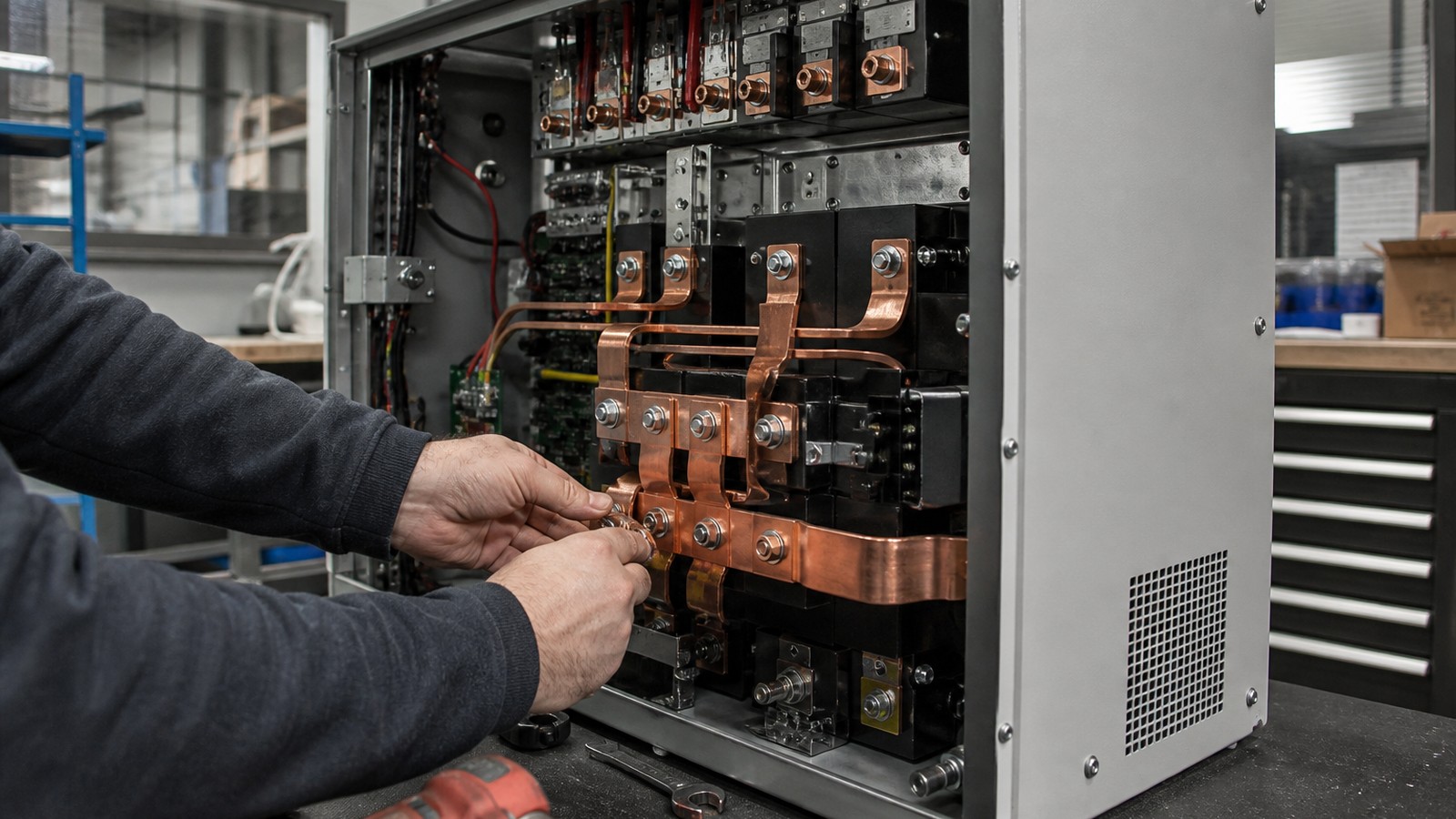
Custom busbar manufacturing
Engineering details are organized around material, tolerance, surface finish, inspection, and production readiness.
Use the inquiry module to send drawings, quantities, standards, and delivery targets for a practical manufacturing review.
Service Details
BusbarMFG is an engineering-first custom busbar manufacturer in Dongguan, Guangdong, China. We build drawing-based copper and aluminum busbars and battery interconnect components used in EV traction inverters, energy storage PCS (Power Conversion Systems), UPS, PV inverters, motor drives, and industrial power electronics.
Our workflow starts with your drawing and application requirements. We review material, thickness, bends, holes, insulation, plating, interfaces, and connection methods, then support prototypes and validation batches through repeat production as your program advances.
What We Make for Inverters and PCS
- DC link busbars: compact connections between capacitor banks and power modules for low-inductance switching.
- Phase busbars: AC output busbars to motor phases, transformers, or filters with controlled creepage and clearance.
- Laminated busbars: multilayer structures where low inductance and tight packaging are critical.
- Insulated busbars: heat-shrink, coated, or sleeved parts for compact assemblies and controlled dielectric spacing.
- Flexible busbars: foil or braided structures to absorb vibration, assembly variation, and thermal expansion.
- Copper busbars: bare or plated (tin, nickel, or silver) for high-current density and stable performance.
- Aluminum busbars: lighter-weight options for projects balancing cost, weight, and conductivity.
- Custom assemblies: drawing-based busbar sets and related high-current interconnect components tailored to your inverter or PCS topology.
Specialized processes such as CCS integrated busbars, overmolding, welding, and certain stamping or forming operations are confirmed case-by-case during technical review.
Typical Applications
- EV traction inverters and DC/DC converters
- ESS PCS: bidirectional DC/AC and DC/DC sections
- UPS and industrial drives
- PV inverters and grid-tied converters
- Rectifier and filter connections in high-current power electronics
Engineering Considerations for Inverter and PCS Busbars
- Electrical performance
- Low inductance paths for fast-switching IGBT or SiC modules
- Balanced current distribution across parallel laminations
- Stable contact resistance via appropriate plating selection (tin, nickel, silver)
- Thermal behavior
- Cross-sectional area and material choice to manage temperature rise under continuous and transient loads
- Thermal path considerations at terminations, interfaces, and laminated stacks
- Insulation, creepage, and clearance
- Dielectric selection (heat-shrink, coatings, sleeves) matched to your voltage class and environmental conditions
- Routing and spacing aligned with standards and internal design rules
- Mechanical design and assembly
- Bend radii, formed features, alignment tabs, and stack-up control for repeatable installation
- Hole sizes, slots, and interfaces suited to bolts, fasteners, or module terminal patterns
- Materials and finishes
- Copper for compact high-current paths and plated surfaces for contact stability or corrosion resistance
- Aluminum for weight and cost optimization with appropriate interfaces and plating strategies
- EMC and reliability
- Minimized loop area and consistent bonding to control EMI
- Vibration and fatigue considerations using flexible or supported structures where needed
Design Options We Support
- Copper busbars
- Solid, flat, or formed parts
- Plating options: tin for general-purpose contact, nickel for higher temperature and hardness, silver for very low contact resistance in select interfaces
- Aluminum busbars
- Lightweight high-current distribution for ESS and EV platforms evaluating copper-to-aluminum transitions
- Laminated busbars
- Multilayer stacks for low inductance and compact packaging between capacitors and power modules
- Insulated busbars
- Heat-shrink, coated, or sleeved configurations for dense assemblies and defined creepage and clearance
- Flexible busbars
- Foil or braided designs to accommodate vibration, assembly tolerances, and thermal movement
Material selection, stack construction, insulation systems, and plating combinations are verified against your specific application during engineering review.
Interfaces and Connection Methods
- Holes, slots, and formed features matched to module terminals, capacitor studs, and chassis mounting points
- Controlled surfaces for bolted or clamped connections
- Tailored geometries for phase separation, polarity routing, and service access
Connection approaches are validated against your electrical, mechanical, and assembly requirements during technical review.
Why BusbarMFG for Inverter and PCS Programs
- Engineering-first approach
- DFM guidance on materials, lamination, insulation, plating, bends, and interfaces based on your drawing and application
- From prototype to repeat production
- Prototypes and validation batches that progress toward confirmed production requirements
- Confidentiality and transparency
- Drawing confidentiality and application-focused manufacturability feedback
- Quality and consistency
- Emphasis on dimensional repeatability, plating and insulation quality, and clear communication throughout the build process
BusbarMFG does not publish unverified certifications, equipment lists, tolerances, lead times, production capacity, or customer claims. Project-specific requirements are confirmed during technical review.
Who We Serve
- EV, ESS, and power electronics OEMs
- Battery module and pack manufacturers
- PCS and inverter makers, UPS and power supply companies
- Charging equipment and electrical distribution equipment manufacturers
- Switchgear and industrial power
- Distribution panels, transformer links, motor drives, and high-current control cabinets
Ideal buyers are engineering-led organizations with ongoing NPI, redesign, localization, or supplier replacement programs. We prioritize inquiries with relevant applications, usable drawings, meaningful order potential, defined timelines, and an engineering or sourcing decision-maker.
DFM and RFQ: What to Send
For an efficient technical review, please include:
- Drawings or 3D models with part numbers or revision levels
- Material requirements (copper or aluminum), target thickness or stack configuration
- Plating or insulation requirements (tin, nickel, silver; heat-shrink, coated, sleeved)
- Quantity and build intent (prototype, validation, pilot, or production)
- Application details (inverter or PCS topology, voltage class, environment)
- Target date or project milestones
CCS integrated busbars, overmolded products, welding, stamping, forming, and other specialized processes are reviewed against the actual project and confirmed capability before they are represented as available production services.
Request Pricing for Inverter and PCS Busbar Applications
Share drawings, material grade, tolerance, surface finish, quantity, and delivery schedule. BusbarMFG will review the requirement and respond with the next step.
Engineering RFQ
Upload Your Drawing
Share drawings or models, material, plating or insulation requirements, quantity, application, and target date. We will review the technical requirements before confirming manufacturing options.
Email: info@busbarmfg.com
Address: Huali Industrial Park, Xianghe Road, Dalang Town, Dongguan City, Guangdong Province, China