
Power Electronics Busbar Applications
Engineering-first custom busbar manufacturing for inverters, rectifiers, UPS, PCS, chargers, and industrial power electronics
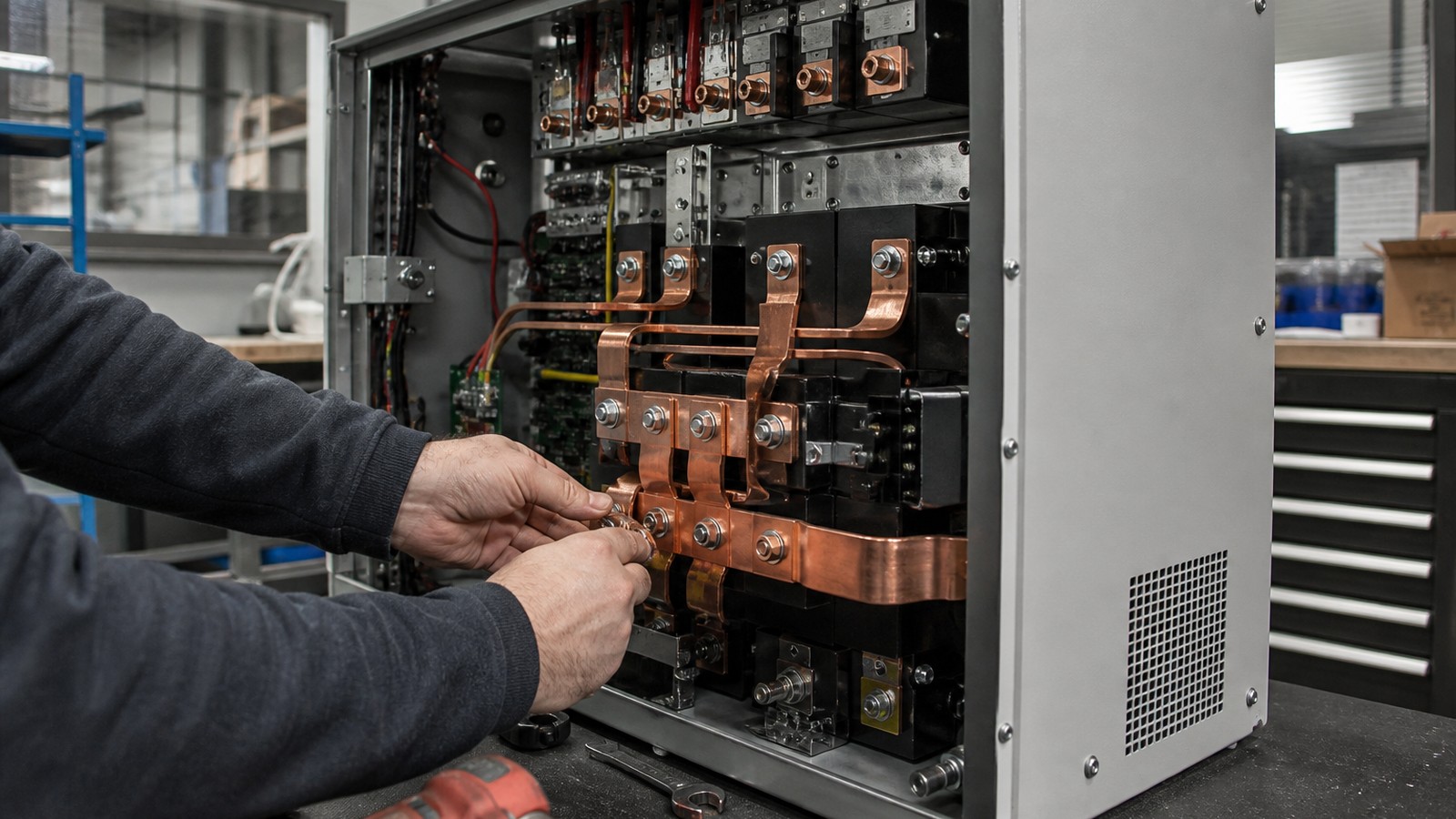
Custom busbar manufacturing
Engineering details are organized around material, tolerance, surface finish, inspection, and production readiness.
Use the inquiry module to send drawings, quantities, standards, and delivery targets for a practical manufacturing review.
Service Details
Engineering-first custom busbar manufacturing for inverters, rectifiers, UPS, PCS, chargers, and industrial power electronics
BusbarMFG designs and manufactures drawing-based copper and aluminum busbars and battery interconnect components for power electronics. From DC links in SiC/GaN power stages to low-inductance laminated busbars for compact converters, we support engineering-led OEMs with DFM feedback, prototypes, validation builds, and repeat production.
Based in Dongguan, Guangdong, China, we serve power electronics programs in the United States, Canada, Europe, the United Kingdom, Australia, and internationally.
Where Our Busbars Fit in Power Electronics
We support new product development, redesigns, localization, and supplier replacement across:
- Inverters, rectifiers, and DC/AC power conversion stages
- DC links and bus structures connecting capacitors and power modules
- UPS, PCS, and high-power power supplies
- DC fast chargers and charging cabinets
- Industrial motor drives and VFDs
- Energy storage power conditioning and battery interfaces
- Switch-mode power and high-current distribution inside cabinets and racks
Typical engineering drivers include compact packaging, low inductance power paths, temperature rise control, assembly repeatability, aluminum cost/weight tradeoffs, and cable-to-busbar conversions.
Busbar Solutions for Power Electronics
- Copper busbars
- Solid, flat, or formed parts in bare copper or with tin, nickel, or silver plating
- Optimized for current density, temperature rise, and joint performance
- Laminated busbars
- Multilayer, low-inductance structures for fast-switching power stages
- Parallel planes and short loops for reduced EMI and improved transient performance
- Insulated busbars
- Heat-shrink, coated, sleeved, or otherwise insulated configurations for compact layouts
- Supports creepage/clearance and partial discharge considerations in high-voltage designs
- Flexible busbars
- Copper foil, braided, or insulated flexible structures to accommodate vibration and assembly tolerance
- Used as compliant links or to decouple thermal expansion in modular assemblies
- Aluminum busbars
- Lightweight, high-current distribution options where copper-to-aluminum conversion is under evaluation
- Design support for bi-metal transitions and joint integrity
- Custom busbar assemblies
- Drawing-based parts and high-current interconnect components integrated to match your assembly approach
Note: CCS integrated busbars, overmolded products, welding, stamping, forming, and other specialized processes must be reviewed against the actual project and confirmed capability before they are represented as available production services.
Engineering Considerations We Review
Our engineering review starts with your drawings and application constraints, then focuses on manufacturability and performance:
- Electrical and thermal
- Current levels, duty cycle, allowable temperature rise, and thermal paths
- Inductance and loop area for fast-switching SiC/GaN stages
- Joint resistance, contact pressure, and torque specifications
- Geometry and interfaces
- Thickness, width, bends, offsets, and stackups
- Holes, slots, chamfers, threads, and insert interfaces
- Capacitor and module interfaces (pad alignment, washer stacks, insulation)
- Insulation and spacing
- Creepage/clearance for your operating voltage and environment
- Heat-shrink, coatings, sleeves, and partial discharge considerations
- Materials and finishes
- Copper or aluminum selection and thickness optimization
- Plating: tin (cost-effective bolted joints), nickel (high-temperature durability), silver (low contact resistance, high-frequency)
- Corrosion and environmental exposure planning
- Assembly and serviceability
- Tolerance stackups and repeatable assembly sequences
- Vibration, shock, and transport-induced movement
- Field service access and modularity
- Transition strategies
- Cable-to-busbar conversions for repeatability and density
- Copper-to-aluminum conversions for cost/weight
Project-specific tolerances, validation plans, and quality controls are confirmed during technical review.
From Drawing to Production-Ready Busbars
We follow a structured engineering-first workflow:
1. RFQ intake
- Submit drawings or 3D models, application details, material and plating/insulation requirements, quantity, and target date
2. DFM and manufacturability review
- Feedback on material, thickness, bends, holes, insulation, plating, interfaces, and connection methods
3. Prototypes and validation
- Prototype or validation batches to confirm fit, function, and assembly
4. Production readiness
- Repeat production upon confirmation of requirements and acceptance criteria
BusbarMFG does not publish unverified certifications, equipment lists, tolerances, lead times, production capacity, or customer claims. Project-specific requirements are confirmed during technical review.
RFQ Checklist for Power Electronics Busbars
Provide the following to enable an efficient technical review and quotation:
- Drawings or models (2D/3D), including:
- Material (copper/aluminum), thickness, and target plating/finish
- Insulation type and target dielectric performance
- Hole sizes, slot features, threads/inserts, and bend/offset details
- Application and performance
- Current, duty cycle, allowable temperature rise, ambient conditions
- Voltage, creepage/clearance constraints, and insulation requirements
- Inductance/EMI considerations (e.g., laminated busbar stackups, return paths)
- Interfaces and assembly
- Mating components (capacitors, modules, posts), fasteners, torque specs
- Assembly sequences and critical tolerances
- Project details
- Prototype vs. validation vs. repeat production
- Required quantities and target dates
- Any special processes requiring review (e.g., CCS integration, overmolding, welding)
Drawings and technical data are handled confidentially and used solely for engineering review and quotation.
Why Engineering-Led OEMs Choose BusbarMFG
- Engineering-first engagement
- Detailed DFM feedback on material, plating, insulation, and interfaces
- Prototype to production support
- Pathway from early samples to repeat production as requirements are confirmed
- Application focus
- Power electronics expertise for low-inductance, compact, and repeatable assemblies
- Transparent communication
- Clear review scope and project-specific confirmations
Frequently Asked Questions
- Do you support laminated busbars for low-inductance power loops?
- Yes, laminated busbars are within our product scope and are commonly used for compact, low-inductance power distribution. Stackups, insulation, and interfaces are confirmed during technical review.
- Can you manufacture aluminum busbars for power electronics?
- Yes. We support aluminum busbars where weight and cost are priorities. We review joint design, plating/finish, and bi-metal transitions to align with your performance targets.
- What plating options are available?
- Common selections include tin, nickel, and silver; the optimal choice depends on environment, temperature, and joint behavior. We confirm feasibility for the specific project.
- Can you provide exact tolerances and lead times?
- These are project-dependent and confirmed during technical review. BusbarMFG does not publish unverified general tolerances or lead times.
- Do you offer CCS-integrated or overmolded busbars?
- Such specialized configurations require case-by-case review and confirmed capability prior to representation as available production services.
Get Started
- Send your drawings/models with material, plating/insulation requirements, quantities, and target dates
- Include application and performance details (current, voltage, temperature rise, inductance/EMI goals)
- Identify your target prototype/validation/production timelines
Our engineering team will review manufacturability and prepare an engineering quotation tailored to your power electronics application.
---
About BusbarMFG
BusbarMFG is an engineering-first custom busbar manufacturer based in Dongguan, Guangdong, China. We manufacture drawing-based copper and aluminum busbars and battery interconnect components for EV battery systems, energy storage, power electronics, charging equipment, switchgear, and industrial power distribution applications.
Request Pricing for Power Electronics Busbar Applications
Share drawings, material grade, tolerance, surface finish, quantity, and delivery schedule. BusbarMFG will review the requirement and respond with the next step.
Engineering RFQ
Upload Your Drawing
Share drawings or models, material, plating or insulation requirements, quantity, application, and target date. We will review the technical requirements before confirming manufacturing options.
Email: info@busbarmfg.com
Address: Huali Industrial Park, Xianghe Road, Dalang Town, Dongguan City, Guangdong Province, China