
Braided Copper Busbar
Custom flexible braided copper connectors engineered from your drawing for EV, ESS, power electronics, charging, switchgear, and industrial power applications.
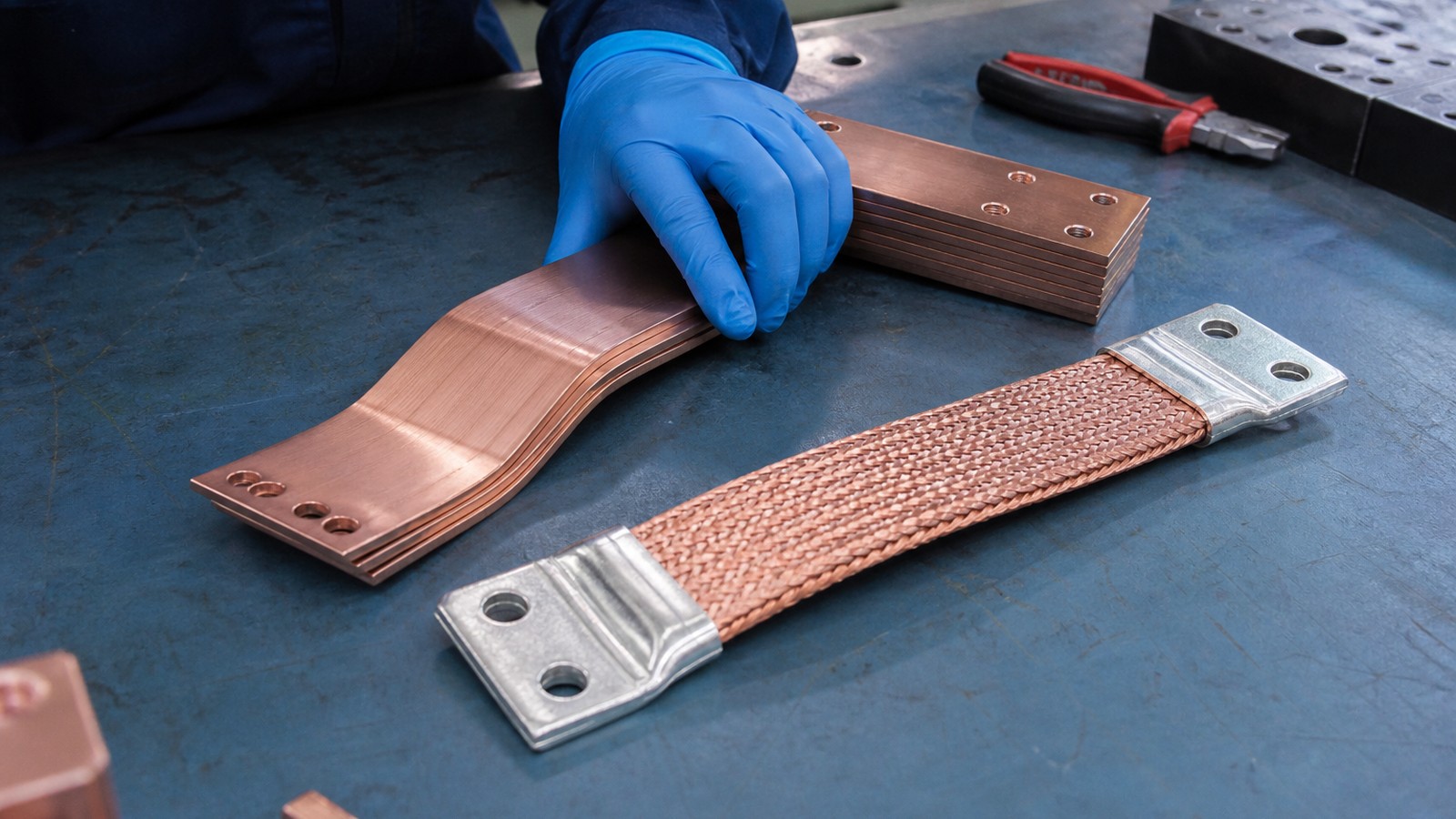
Custom busbar manufacturing
Engineering details are organized around material, tolerance, surface finish, inspection, and production readiness.
Use the inquiry module to send drawings, quantities, standards, and delivery targets for a practical manufacturing review.
Service Details
Custom flexible braided copper connectors engineered from your drawing for EV, ESS, power electronics, charging, switchgear, and industrial power applications.
What Is a Braided Copper Busbar?
A braided copper busbar (also called copper braid connector, braided shunt, or bonding braid) is a flexible conductor made from many fine copper wires woven into a flat or tubular braid. It is used where vibration, thermal expansion, assembly tolerance, or service movement requires electrical continuity with mechanical flexibility.
Compared with solid or laminated busbars, braided copper busbars:
- Accommodate vibration and repeated flex cycles
- Tolerate assembly misalignment and thermal growth
- Help reduce stress on terminals and joints
- Enable low-resistance, high-current connections in constrained spaces
Typical configurations include bare or tinned copper braid with custom-machined or formed end tabs, holes, and insulation options to match your assembly.
From Drawing to Production-Ready Flexible Busbars
BusbarMFG is an engineering-first busbar manufacturer based in Dongguan, Guangdong, China. We build custom, drawing-based copper and aluminum busbars and flexible interconnects for EV battery systems, energy storage, power electronics, charging equipment, switchgear, and industrial power distribution.
Our workflow:
- Engineering review of your drawing and application
- DFM feedback on braid size, construction, end interfaces, thickness, insulation, plating, holes, and tolerances
- Prototype or validation batches
- Progression to repeat production once requirements are confirmed
When to Choose Braided vs. Other Flexible Options
- Braided copper busbar: Best for high flexibility, vibration, frequent movement, or where a compliant interconnect eases assembly.
- Foil flexible busbar: Good for compact, low-inductance “leaf” style stacks with defined bend planes.
- Insulated flexible busbar: When touch safety, compact routing, or creepage/clearance control is required.
BusbarMFG manufactures flexible busbars across braid, foil, and insulated styles and can advise on tradeoffs during review.
Engineering-First Review Topics
Electrical
- Target current and permissible temperature rise
- Cross-sectional area of braid, resistance, and heat management
- Plating and contact resistance at interfaces
- Inductance and loop geometry for fast-switching power electronics
Mechanical
- Required movement, bend radius, and cycle life
- Length of the elastic flex section and stiffness transitions
- Hole sizes, patterns, edge distance, and stack-up tolerances
- Mounting interfaces, hardware clearance, and strain relief
Materials and Environment
- Copper grade and braid construction (flat or tubular; bare or tinned wire)
- End fitting material and plating (tin, nickel, or silver, as specified)
- Insulation method (heat-shrink, coated, sleeved) and creepage/clearance
- Ambient temperature, vibration, humidity, and corrosion exposure
- Galvanic compatibility at aluminum or mixed-metal interfaces
Materials and Options
- Braid conductor: Copper braid (bare or tinned). Oxygen-free or ETP copper reviewed case-by-case.
- Braid construction: Flat or tubular braid; wire gauge, strand count, and weave density per drawing.
- End terminations: Custom copper end tabs, machined blocks, or formed interfaces per drawing. Termination methods and joining processes are confirmed during technical review.
- Plating: Tin, nickel, or silver on end fittings as specified.
- Insulation: Heat-shrink, sleeves, or coatings to meet creepage/clearance and assembly requirements.
- Marking/ID: Part numbers, polarity, or location marks as required on drawing.
Note: Welding, stamping, forming, overmolding, and other specialized processes are reviewed against the actual project and confirmed before they are represented as available production services.
Typical Applications
- EV battery module and pack interconnects
- Energy storage racks and containers
- Inverters, rectifiers, PCS/UPS and high-current DC links
- On-board chargers and DC fast charging equipment
- Switchgear, distribution panels, transformer connections
- Motor drives, automation cabinets, and industrial power supplies
DFM Tips for Braided Copper Busbars
- Define current, allowable temperature rise, duty cycle, and ambient conditions.
- Size braid cross-section for both steady-state current and short-term overloads or fault conditions.
- Provide a flexible section long enough to accommodate movement; avoid tight bend radii.
- Specify hole size, pattern, and tolerances; keep adequate edge distance around holes.
- Call out end fitting thickness and plating to match hardware and mitigate galvanic issues.
- Define insulation type, thickness, color, and required creepage/clearance distances.
- Indicate expected vibration level, movement cycles, and installation constraints.
- For aluminum interfaces, request evaluation of bimetallic or surface treatments.
- Include inspection points important to your process (e.g., hole position, overall length).
What to Include in Your RFQ
For an efficient technical review, please provide:
- 2D drawings and/or 3D models
- Material and plating requirements (braid and end fittings)
- Braid style and size (flat/tubular, target cross-section or resistance)
- End termination design: tab thickness, hole sizes/patterns, interface notes
- Insulation requirements and any marking
- Operating current, temperature rise targets, environment, and movement specs
- Quantities: prototypes/validation and estimated production volumes
- Application summary and target date
BusbarMFG uses this information to assess manufacturability and prepare an engineering quotation.
Request Pricing for Braided Copper Busbar
Share drawings, material grade, tolerance, surface finish, quantity, and delivery schedule. BusbarMFG will review the requirement and respond with the next step.
Contact BusbarMFG
Get in touch with our engineering team for custom busbar manufacturing inquiries. We provide precision-engineered solutions for your power distribution needs.
Huali Industrial Park, Xianghe Road, Dalang Town, Dongguan City, Guangdong Province, China