
Flat Copper Busbar
Engineering-first, drawing-based manufacturing of custom flat copper busbars for EV battery systems, energy storage (ESS), power electronics, charging equipment, switchgear, and industrial power distribution.
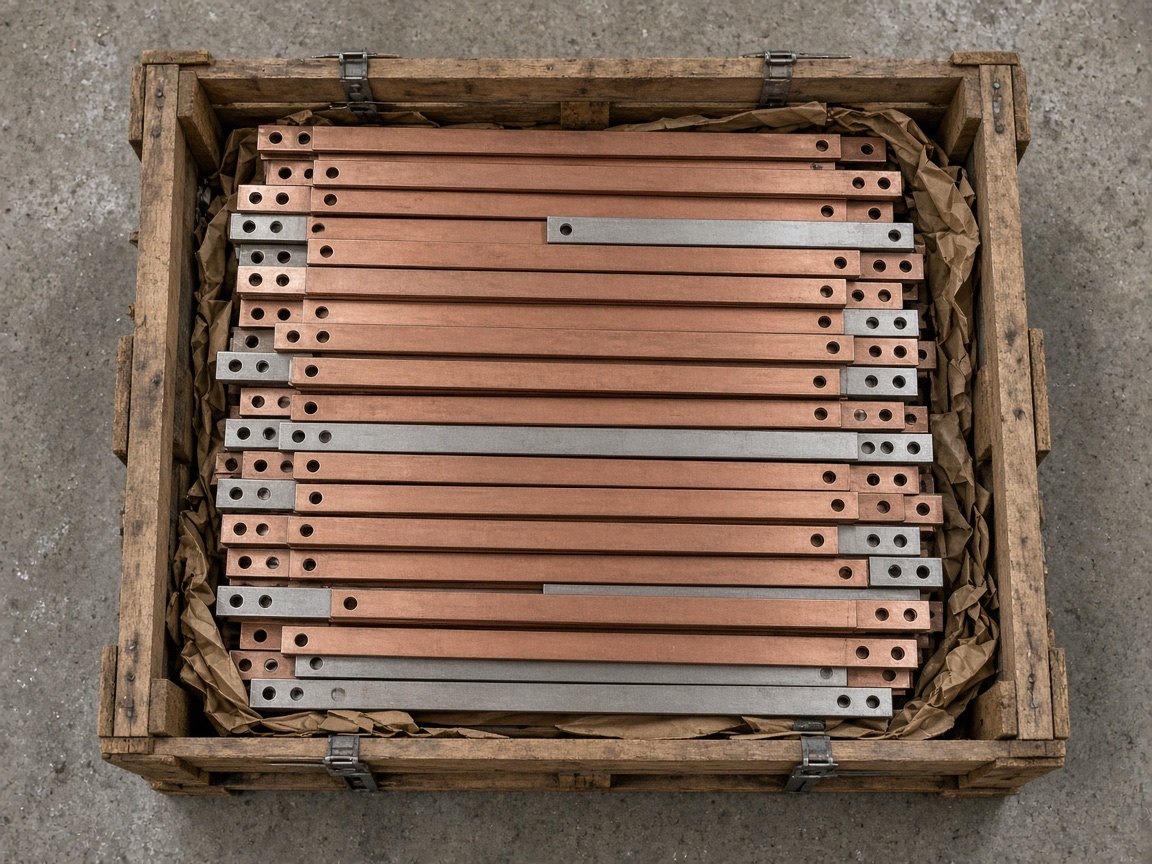
Custom busbar manufacturing
Engineering details are organized around material, tolerance, surface finish, inspection, and production readiness.
Use the inquiry module to send drawings, quantities, standards, and delivery targets for a practical manufacturing review.
Service Details
Engineering-first, drawing-based manufacturing of custom flat copper busbars for EV battery systems, energy storage (ESS), power electronics, charging equipment, switchgear, and industrial power distribution.
BusbarMFG is an engineering-led custom busbar manufacturer in Dongguan, Guangdong, China. We build to your drawings and application requirements, starting with technical review and moving through prototypes, validation batches, and repeat production once specifications are confirmed.
- Scope: solid flat copper busbars, straight or formed, with specified holes/slots, bends, plating, and insulation
- Programs: new product development, redesigns, localization, or supplier replacement
- Buyers: electrical/mechanical/battery/power electronics engineers; sourcing and commodity managers at OEMs
---
What Is a Flat Copper Busbar?
A flat copper busbar is a solid, single-layer copper conductor designed to carry high current with predictable thermal performance and repeatable assembly. Compared with cables, flat busbars improve dimensional consistency, reduce assembly variation, and can simplify packaging. Compared with laminated busbars, flat busbars offer straightforward construction when inductance reduction or multi-layer routing is not the primary driver.
Typical uses include:
- EV and ESS battery module/pack interconnects and distribution links
- DC link and DC distribution in inverters, PCS, UPS, and power supplies
- Charging equipment, rectifiers, and power distribution cabinets
- Switchgear, transformer connections, motor drives, and industrial control panels
---
Why Choose a Flat Copper Busbar
- High conductivity and thermal path: copper enables compact cross-sections for given current and temperature rise targets
- Assembly repeatability: precise geometry for holes, slots, and bends improves fit, torque, and electrical contact consistency
- Packaging efficiency: thin, flat profiles route current in tight spaces and along defined clearances
- Serviceability: defined interfaces support standardized fasteners, insulation, and labeling
- Cost and weight tradeoffs: a direct alternative to cable assemblies; copper-to-aluminum redesigns can be evaluated case-by-case
If you need very low inductance, multi-layer routing, or embedded capacitance, consider our laminated busbar review. For vibration accommodation or tolerance stack-up, flexible busbars may be appropriate.
---
Engineering and DFM Support
Our workflow starts from your drawing and application targets. We review manufacturability and risk across:
- Material and thickness: high-conductivity copper grades commonly specified (e.g., C110 or equivalent), thickness per current and thermal requirements
- Geometry: bends, offsets, and flat sections intended to meet package and assembly needs
- Interfaces:
- Holes and slots sized for your fasteners, washers, and torque targets
- Keepouts and masks for plating and insulation at contact surfaces
- Burr direction and surface prep for reliable, low-resistance joints
- Plating selection:
- Tin: general-purpose corrosion protection and contact stability
- Nickel: higher temperature and wear resistance
- Silver: low contact resistance for demanding joints
- Insulation strategy (if required): heat-shrink, coatings, sleeves, or other methods reviewed for creepage/clearance and assembly
- Thermal and electrical goals: current, temperature rise, ambient, airflow, stacking, and mounting conditions
- Documentation: GD&T, special characteristics, inspection points, and any program-specific requirements
We confirm feasible tolerances, inspection plans, and process routes during technical review. If specialized processes (e.g., stamping, forming, welding, overmolding, CCS-integrated features) are required, capability is verified against the actual project before being offered as a production service.
---
Materials and Finishes for Flat Copper Busbars
- Base material: high-conductivity copper as specified on your drawing
- Plating options: tin, nickel, or silver per your specification
- Surface prep: deburring, edge conditioning, and contact-surface preparation aligned to your joint design
- Marking and identification: part number, revision, polarity, or other markings as required
Finish selection influences contact resistance, corrosion behavior, and assembly torque. We align the finish to the electrical interface and environment you specify.
---
Insulation Options
When insulation is required for compact assemblies or operator safety, we review options and confirm them against your creepage/clearance and installation constraints:
- Heat-shrink sleeving
- Coatings or encapsulating layers
- Insulation sleeves or boots
- Partial masking and keepouts for contact surfaces
Insulation material, coverage, thickness, color, and test methods are defined during engineering review.
---
Manufacturing Workflow
- Technical review: drawing, application, and risk assessment; manufacturability feedback
- Prototypes/validation: initial parts for fit checks, electrical tests, and thermal validation
- Refinement: drawing and requirement updates based on test feedback
- Repeat production: confirmed process flow, inspection plan, and packaging agreed with your team
Process routes (e.g., cutting, forming, surface prep, plating, insulation, assembly) are project-specific and confirmed during review.
---
Quality and Inspection
We support engineering-led programs that require consistent geometry, reliable plating/insulation, and clear communication.
- Drawing-driven inspection: critical dimensions, bend features, and hole positions per your print
- Visual and surface checks: edge condition, plating coverage, insulation integrity
- Documentation: agreed inspection records and traceability to meet your program needs
We do not publish generalized certifications, tolerances, or equipment lists; project-specific quality requirements are confirmed during technical review.
---
Flat Copper vs. Aluminum and Laminated Options
- Flat copper busbar:
- Best for compact cross-sections, straightforward routing, and robust bolted joints
- Flat aluminum busbar:
- Consider for weight/cost targets; joint design, surface finish, and corrosion controls reviewed
- Laminated busbar:
- Consider for low-inductance multi-layer distribution, tight EMI control, or compact stacked routing
- Flexible busbar:
- Consider where vibration, tolerance stack-up, or service access drives compliance
We can review copper-to-aluminum redesigns and cable-to-busbar conversions with your team.
---
Request Pricing for Flat Copper Busbar
Share drawings, material grade, tolerance, surface finish, quantity, and delivery schedule. BusbarMFG will review the requirement and respond with the next step.