
Busbar Material Guide
An engineering-first reference for selecting copper, aluminum, flexible, insulated, and laminated busbar constructions for EV battery systems, energy storage, power electronics, charging equipment, switchgear, and industrial power distribution.
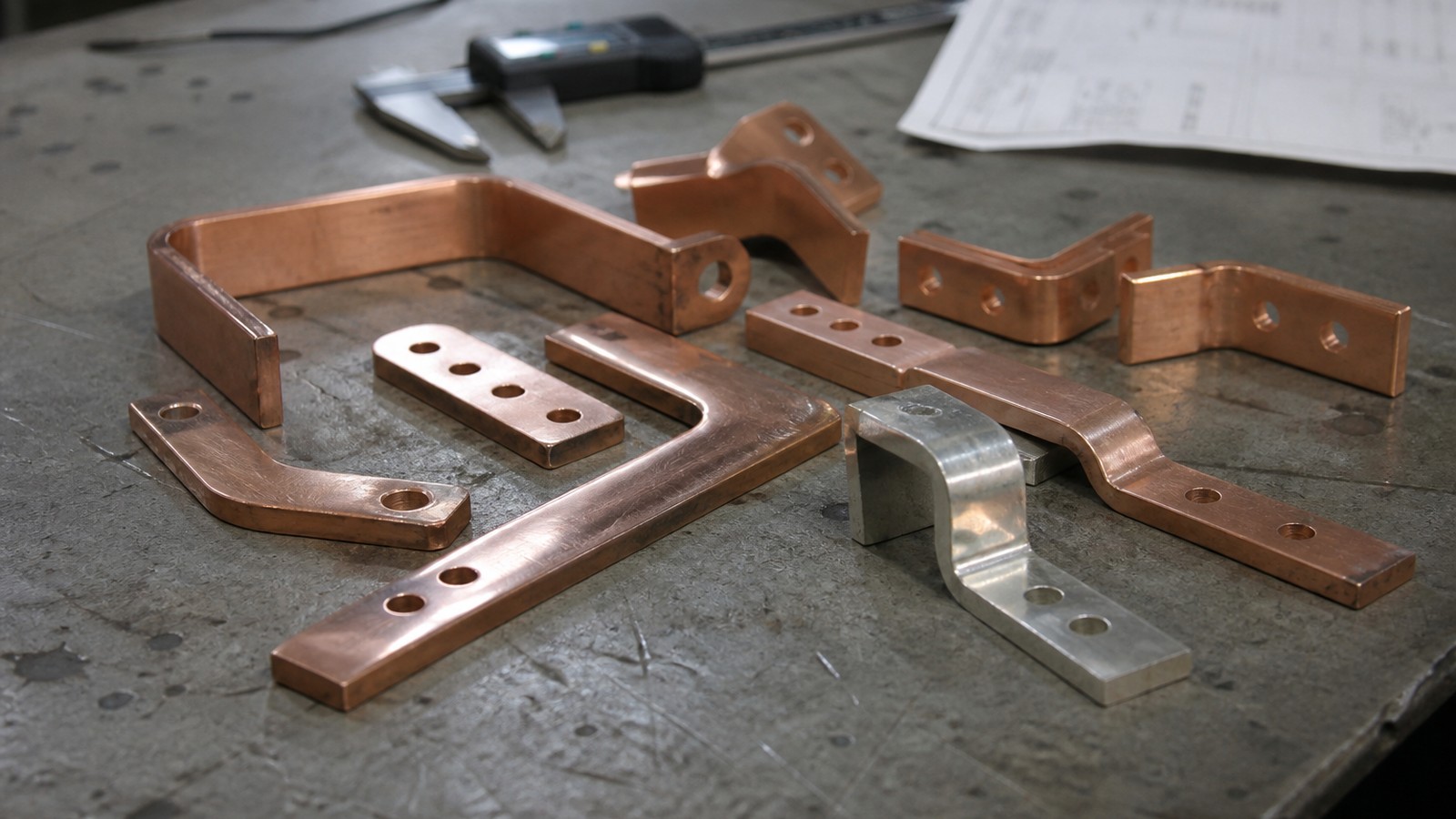
Custom busbar manufacturing
Engineering details are organized around material, tolerance, surface finish, inspection, and production readiness.
Use the inquiry module to send drawings, quantities, standards, and delivery targets for a practical manufacturing review.
Service Details
An engineering-first reference for selecting copper, aluminum, flexible, insulated, and laminated busbar constructions for EV battery systems, energy storage, power electronics, charging equipment, switchgear, and industrial power distribution.
BusbarMFG is a drawing-based custom busbar manufacturer in Dongguan, Guangdong, China. We support engineering-led OEMs from prototype through repeat production. This Busbar Material Guide summarizes practical selection factors and typical options our team reviews during an engineering RFQ.
Note: BusbarMFG does not publish generic tolerances, lead times, capacity, certifications, or customer claims. Project-specific requirements are confirmed during technical review.
Who this guide is for
- EV battery module and pack manufacturers, ESS integrators, inverter/PCS/UPS makers, charging equipment OEMs, power supply companies, and electrical distribution equipment manufacturers
- Engineering and sourcing roles: Electrical/Mechanical/Battery Engineers, Power Electronics Engineers, NPI/R&D Managers, Sourcing/Commodity/Procurement Managers
- Teams evaluating copper-to-aluminum cost or weight tradeoffs, cable-to-busbar redesigns, low-inductance layouts, tighter packaging, and prototype-to-pilot transitions
From drawing to production-ready busbars
Our workflow begins with your drawing or model and application requirements. We review material, thickness, plating or insulation, bends, holes, interfaces, and connection methods. Projects often start with prototypes or validation batches, then progress to repeat production as requirements are confirmed. Certain specialized processes (for example CCS-integrated or overmolded structures, welding-heavy assemblies, deep-draw stamping) must be reviewed against the actual project and confirmed before being represented as available services.
Core material options and when to use them
Copper busbars
Best for:
- High conductivity and compact cross-sections
- Tight thermal rise limits and repeatable bolted interfaces
- Low-inductance laminated busbars in converters and inverters
Common copper choices:
- ETP copper (C110): general-purpose high-conductivity copper for solid, formed, or laminated busbars
- Oxygen-free copper (C102/C101): preferred where hydrogen embrittlement risks, vacuum, or cleanliness are critical
- Machinable coppers (e.g., tellurium copper) may be considered for complex threaded or machined features
Surface finish:
- Bare copper where protected environments and controlled assembly are expected
- Tin plating for general-purpose bolted joints and mixed-fleet hardware compatibility
- Nickel plating for higher temperature environments or where tin creep must be minimized
- Silver plating for the lowest contact resistance and high-frequency/low-loss interfaces (tradeoff: tarnish behavior to be managed)
When to consider copper:
- Compact packaging with high current density
- Bolted or laminated interfaces needing consistent, low-resistance joints
- Prototypes advancing toward validation where predictable plating and insulation quality are critical
Aluminum busbars
Best for:
- Weight and cost reduction programs
- Larger cross-sections acceptable to meet ampacity and thermal rise
- Battery pack and ESS interconnects where aluminum structures align with enclosure and thermal strategies
Common aluminum choices:
- Electrical aluminum alloys used for busbars include EC-grade and conductor-focused alloys (e.g., 6101 series); alloy and temper selection is tied to conductivity, formability, and mechanical needs
- Structural aluminum alloys (e.g., 6xxx series) can be used where mechanical features or forming take priority over maximum conductivity
Surface and interfaces:
- Aluminum forms an oxide layer; joint design, surface prep, and compatible hardware are critical
- Options include bolted joints using compatible platings and hardware, bi-metal transitions for Cu–Al connections, and process-specific joining solutions
- Tin or nickel finishes on aluminum may be considered but require proper pretreatment and process control; feasibility is reviewed per project
When to consider aluminum:
- Platform-level copper-to-aluminum cost or weight reduction
- Large-format ESS busbars where cross-sectional area and envelope allow
- Battery module interconnects designed around aluminum cells and thermal pathways
Flexible, insulated, and laminated constructions
- Flexible busbars: stacked copper foils or braided flex designed to absorb vibration, assembly variation, and thermal expansion. Useful for battery module interconnects and equipment tolerances.
- Insulated busbars: heat-shrink, sleeves, or coated/over-sheathed designs for compact, safer assembly and controlled creepage/clearance. Insulation type, thickness, and color are defined by the application.
- Laminated busbars: multilayer copper (or aluminum) with insulation between layers for low-inductance, compact DC link and power distribution. Diminishes loop area to reduce switching noise and EMI in power electronics.
These constructions are selected based on current, inductance targets, environmental exposure, assembly tolerance stack-up, and serviceability.
Plating and surface finish selection
- Tin plating
- Pros: widely compatible with hardware, stable bolted joints, cost-effective
- Typical uses: general power distribution, ESS modules, switchgear, mixed-metal hardware interfaces
- Nickel plating
- Pros: high-temperature tolerance, mechanical robustness
- Typical uses: high-temp environments, plated threads or wear-prone areas
- Silver plating
- Pros: lowest contact resistance, favorable for high-frequency and precision interfaces
- Considerations: tarnish behavior; storage and handling need definition
- Bare copper or aluminum
- Pros: cost and simplicity where environment is controlled
- Considerations: oxidation and joint stability must be managed via design and assembly practices
Note: Final plating choice should be matched to the mating hardware plating, environment, temperature, and maintenance practices.
Battery and EV-specific considerations
- Weight and cost: aluminum can reduce mass; copper delivers compact cross-sections and stable joints. Some packs blend both via bimetal transitions.
- Cu–Al transitions: galvanic compatibility requires strategy. Options include bimetal transition plates, specialized joining techniques, or carefully selected platings and hardware. We review feasibility per project.
- Vibration and tolerance: flexible links help absorb movement between modules; laminated or insulated designs enhance packaging density and safety.
- Thermal rise and short-circuit: cross-section, path length, and stackup are selected to manage temperature rise and withstand fault conditions as defined by your standards and tests.
- Insulation and creepage/clearance: coatings, sleeves, and laminated dielectrics enable compact layouts while meeting safety and spacing requirements.
Request Pricing for Busbar Material Guide
Share drawings, material grade, tolerance, surface finish, quantity, and delivery schedule. BusbarMFG will review the requirement and respond with the next step.
Engineering RFQ
Upload Your Drawing
Share drawings or models, material, plating or insulation requirements, quantity, application, and target date. We will review the technical requirements before confirming manufacturing options.
Email: info@busbarmfg.com
Address: Huali Industrial Park, Xianghe Road, Dalang Town, Dongguan City, Guangdong Province, China